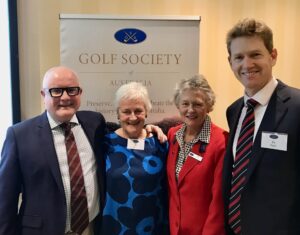
Dinner report by John Trevorrow
“The connections between The Royal Melbourne Golf Club,
Flinders Golf Club and Dr Alister MacKenzie.”
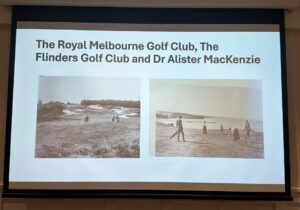
The third and final Golf Society dinner for 2025 drew a large crowd to hear a presentation from Andrew Kirby about the connections between The Royal Melbourne Golf Club, Flinders Golf Club and Dr Alister MacKenzie. It was fitting that this talk was given at Royal Melbourne, the club that brought Dr MacKenzie to Australia from Britain in 1926 for his sweeping visit to five Australian states and New Zealand that changed the trajectory of golf course design in this part of the globe.
Andrew Kirby is a long-time member of RMGC and Flinders. He is a former Captain at RM and is chair of the disciplinary committee of Flinders GC. He is a very keen golfer and student of the game, and his presentation painted a vivid picture of the web of connections going back more than a century between both of these venerated golf clubs.
He began by revealing that the founding of Flinders GC in 1903 was thanks in large part to David Maxwell, the first club champion at Royal Melbourne. Maxwell was working in the Flinders area and saw the potential for a golf course, pushed to get it built and eventually became a club founder and the first Flinders GC secretary from 1903 to 1936. Flinders in those pre-automobile days was a far-flung outpost, not the easy 100km drive from Melbourne that it is today. Golfers and holiday-makers in 1903 would mostly arrive by train at Frankston or Bittern railway stations, then travel 15 or 20km over a couple of hours by horse and buggy.
The other links described by Andrew included:
- Close connections between many members of both clubs by family or marriage.
- Business titan Sir John Holland was president of Royal Melbourne and was born and raised at Flinders. He had a house on the 9th hole, and once led a protest against a proposed change that would have meant the loss of ‘Aunt Sally’, the delightful par-3 12th hole with magnificent views of Bass Strait and Phillip Island from its elevated tee box where hole distances range from 140m to 88m to the green well below.
- Ranald Macdonald, another business legend and Flinders local, is a former RM club champion and at 86 still sits today on the Flinders GC disciplinary committee. (Hopefully very few decisions are needed!)
- Finally, the most famous connection of all is the 1926 visit of Dr MacKenzie. He advised on the removal of two famous holes on the cliff facing Western Port — one downhill and the other back up — and changed The Coffin hole from a par-3 to a short 4 with carries over two ravines – the ‘Coffin’ and ‘Purgatory’.
Andrew also speculated on the famous suggestion that 1926 was the good doctor’s second visit. A much-disputed theory is that he visited in 1902 while working as a ship’s surgeon, in the era when he was interested in golf architecture but had not formally begun that career. Andrew cited possible evidence that includes:
- Dr MacKenzie is speculated to be a cousin of David Maxwell’s wife, and may have taken the opportunity to visit while his ship was in the area.
- The former hole up the hill was called ‘Spion Kop’, an Afrikaans word meaning ‘spy hill’ that is also the name of a Boer War battle. Dr MacKenzie in 1902 had recently returned from that war and may have suggested the name for the hole, even though he recommended in 1926 removing it because of the arduous nature of playing up the cliff.
This mystery, like the allure of Royal Melbourne and Flinders golf courses, endures to this day.
John Trevorrow